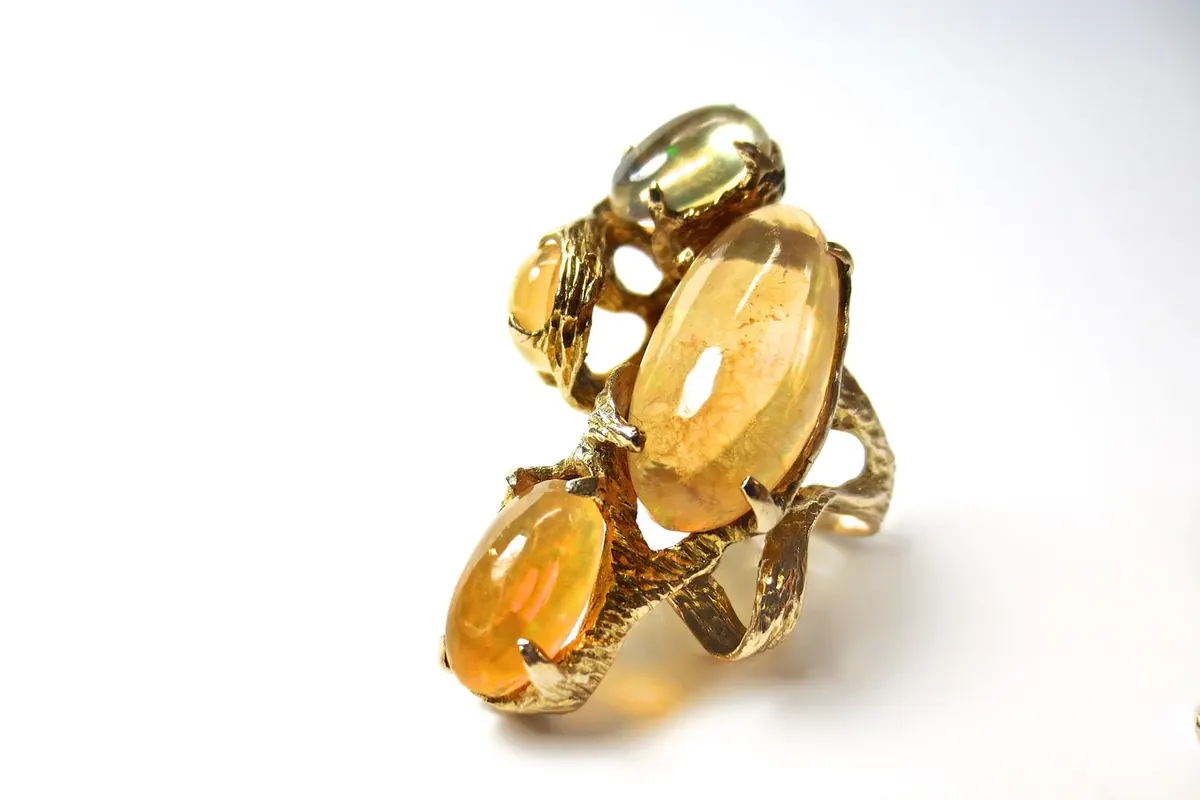
Put three opals side by side and you will quickly see why they confuse beginners. One glitters with tiny green and blue points, another holds a single bar of red, and a third looks flat grey until you tilt it towards the light. None of them is faulty. Opal is the gemstone most associated with play-of-colour, and that colour refuses to sit still.
Once you know which words to use, the fog clears. You stop saying “it’s a nice one” and start saying “dark body, bright green-blue flash, rolling pattern”. That is a description a jeweller, a gemmologist or a seller can work with — and it is what makes comparing two stones possible.
Body tone and play-of-colour are two different things
Every opal has two colours to think about at once. The body tone is the background colour you see when the stone is not flashing: black, dark grey, milky white, or somewhere in between. The play-of-colour is the shifting display of spectral light that sits on top of that background and moves as you turn the stone.
Separating the two is the single most useful habit a beginner can build. A black opal with a weak, muddy flash is less interesting than a white opal with brilliant green and violet. Learn to describe the background and the flash independently, and you will never be talked into a stone by the words “black opal” alone.
Reading body tone from black to white
The trade sorts body tone along a scale that runs from very dark to very light. At the dark end sit black and dark opals; in the middle, grey and semi-black; at the light end, white and crystal. Crystal opal is a useful term to know: it means the body is transparent or near-transparent rather than milky, so the play-of-colour appears to float inside the stone with unusual clarity.
Two points worth remembering. First, “black opal” in the trade does not simply mean a black stone — it means a stone with a dark body and visible play-of-colour. Second, body tone is not a ranking of quality on its own. Dark backgrounds usually make colours read more vividly because of the contrast, but a superb white or crystal opal can outshine a dull dark one. Some stones, notably boulder opals, are cut with their ironstone host rock attached, so part of what you see is the rock rather than the opal body.
Brightness: how hard the colour comes back at you
Brightness describes the strength of the returning colour. Descriptors run roughly from faint and dull, through moderate, to bright and brilliant, and the industry often compresses this into a numbered scale of one to five.
How you look matters as much as what you look at. A strong shop spotlight flatters almost any opal, and direct sunlight can wash colours out. Take the stone to a window, or better, into open shade, and view it at arm’s length rather than pressed against your eye. Then tilt it slowly through a full turn and ask two questions: how far across the stone does the colour travel, and how much of that turn keeps it alive? A stone that flashes brilliantly for ten degrees and then goes quiet is doing less work than one that glows throughout.
The main pattern names
Pattern is the shape the colour takes. These are the terms you will meet most often, and many stones combine several:
- Pinfire — many small, distinct points of colour, like scattered sparks.
- Flash — broad, single areas of colour that appear and vanish as you tilt.
- Harlequin — a mosaic of roughly square or rectangular patches, highly prized and uncommon.
- Flagstone — similar to harlequin but with irregular, uneven blocks.
- Ribbon or Chinese writing — elongated, stroke-like bands of colour.
- Straw — fine, thin lines crossing the stone.
- Rolling flash — colour that sweeps across the face as the stone moves, rather than blinking on and off.
Pattern names are descriptive, not competitive. A crisp pinfire with intense colour can be more captivating than a loose flagstone, so use the vocabulary to see clearly rather than to rank.
What colours appear, and why background matters
Play-of-colour can show any spectral hue: red, orange, yellow, green, blue and violet. Reds are the least common and usually the most sought after, particularly when they sit against a dark body, while greens and blues are far more plentiful. Some stones flash one dominant colour; the best show several at once, shifting from green to gold to red within a single turn.
Here is a trick worth trying the next time you handle an opal. Put it on a sheet of white paper, then on black cloth. The body reads lighter on white and the flash seems to dim; on black the colours tighten and brighten. Neither view is wrong — it simply shows how much of what you see is contrast. Judge the stone in daylight against a neutral grey or your own skin, and you will get the fairest reading.
Comparing two opals in the hand
When you have two stones in front of you, work through the same short routine every time:
- Note the body tone in one word: black, dark, grey, white or crystal.
- Note the dominant play-of-colour and any secondary colours.
- Name the pattern, or describe it if no single name fits.
- Rate brightness out of five, in shaded daylight rather than under a spotlight.
- Turn the stone slowly through a full circle and check how much of that turn shows colour.
- Look for dead spots — areas with no colour at all — and judge how much of the face they occupy.
Write your notes down. Within a dozen stones you will have a personal reference list, and your eye will start making these judgements automatically.
Getting your eye in
The fastest way to learn is repetition with the same light source. Look at opals whenever you can, in the same place, and compare them against your notes rather than against a seller’s adjectives. Ask to see a stone in daylight before you decide — a reasonable request that any reputable dealer will accept. Pay attention to orientation too: how a cutter positions the colour bar decides how the finished stone behaves, and two stones from the same rough can look entirely different.
A little practical care is also worth knowing from day one. Opal is softer than most faceted gemstones and can craze — develop fine surface cracks — if it dries out or is knocked about, so store pieces padded and away from radiators, avoid ultrasonic cleaners and household chemicals, and take rings off before gardening or DIY. Some opals, particularly certain Ethiopian material, are porous and can absorb water or oils, which may temporarily affect their appearance; if you own one of these, treat it gently. For cleaning, lukewarm water and a soft cloth are usually enough, and for anything involving value, treatment or a suspected crack, ask a qualified gemmologist or jeweller rather than guessing.
Colour is the whole point of opal, and it rewards patience. Learn body tone, brightness, pattern and play-of-colour as four separate ideas, use them when you describe what you see, and you will compare stones the way the trade does — clearly, and on your own terms.
Photo: JerzyGórecki / Pixabay