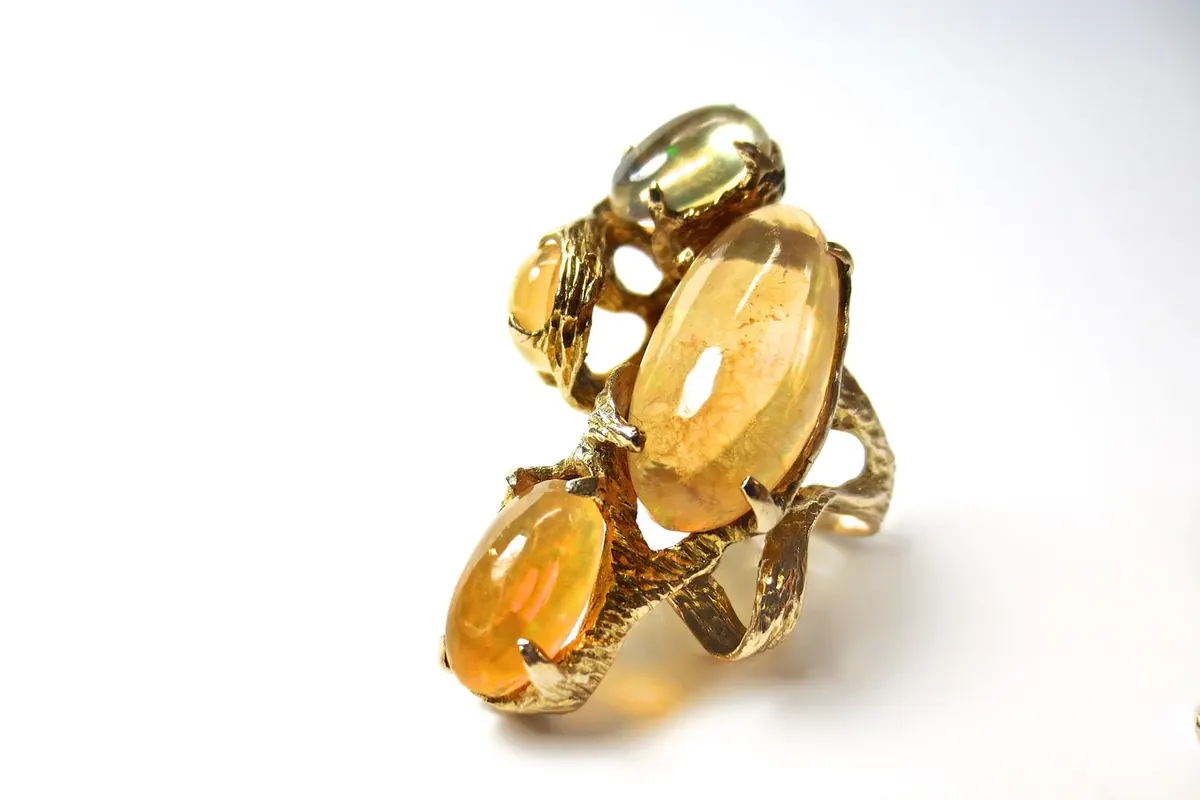
An opal ring is one of those purchases where a single photograph can make the decision for you — and that is exactly the problem. A well-lit shot of a crystal opal can glow like something out of a dream; the same stone under a kitchen ceiling can look like a grey pebble. Buyers who know what to ask for end up with a ring they wear for decades. Buyers who don't end up with a size M that fits like an L, a "black opal" that turns out to be a doublet, and a seller who has stopped answering emails.
None of this requires suspicion of every seller. Most people in the opal trade are straightforward. It requires knowing which details matter before money changes hands — and asking for them plainly.
Trusting a Photo Taken Under Ideal Light
Every opal is photographed at its best. Sellers tilt the stone towards a window, wet it, or use a lightbox, and the fire in the image is genuinely there — just not always visible in ordinary conditions. The gap between "photographed beautifully" and "looks like that on your hand in a dim room" is the most common source of disappointment.
Ask for a short video before you commit. Two, ideally: one in daylight near a window, one indoors under normal lighting, no flash. Then ask two direct questions:
- What does the stone look like in flat, dull indoor light?
- How does the play of colour change when the ring is on a hand rather than a white background?
A seller who answers honestly, and sends the video you asked for, is worth your money. One who replies with a fresh batch of heavily edited stills is telling you something useful.
Not Asking What Type of Opal You Are Buying
This is where money is most often lost. "Opal" in a listing can mean three quite different things, and the price gap between them is wide.
Solid
A solid opal is a natural stone, cut and polished whole. It is the most durable and the most valuable, and it is what most people picture when they imagine an opal ring.
Doublet
A doublet is a thin slice of natural opal glued to a backing, often dark potch or ironstone. The backing makes the colour appear darker and stronger. A doublet can be lovely and perfectly honest — as long as it is described as one.
Triplet
A triplet adds a clear quartz or glass cap over a thin opal slice. Cheaper again, and more vulnerable to scratching, because the cap takes the knocks.
Ask directly: is this a solid natural opal, or a doublet or triplet? Has it been treated, dyed or stabilised? Is it lab-created? Resin and glass also turn up described loosely as opal. Ethiopian opal deserves its own question, because much of it is hydrophane — it can absorb water and turn temporarily cloudy or paler, usually returning to normal as it dries. That is not a fault, but oils and lotions are best kept away from it.
Ignoring Where the Opal Came From
Origin is not just a romantic detail; it hints at how a stone behaves. Australian opal from Lightning Ridge, Coober Pedy or Mintabie tends to be stable and hard-wearing. Much Ethiopian material is water-sensitive, as above. Mexican fire opal is usually more transparent and orange-bodied. Brazilian and Honduran opal exists in smaller quantities.
Ask where the stone was mined and, if possible, who cut it. For a modest ring, a verbal answer is fine. On a significant purchase, a vague or shifting answer — "Australian-style", "from our supplier" — is a reason to walk away. Certificates are not standard for inexpensive stones, so don't be alarmed by their absence; just be wary of a grand claim with nothing behind it.
Getting the Ring Size Wrong
Ring sizing is not standardised, and "size 7" means nothing without knowing which system the seller uses. Before you order:
- Measure the internal diameter of a ring that already fits, in millimetres. That number travels better than a letter or a number.
- Measure at the end of the day, when fingers are at their largest. Cold hands and early mornings give you a size that is too small.
- Measure the exact finger on the exact hand you will wear it on. Your dominant hand is usually slightly larger.
- Allow room for a wide band. A 6 mm band feels tighter than a 2 mm band at the same size, so consider going up a quarter or half size.
- Ask whether the ring can be resized later. Inlay, channel-set stones and certain bezel settings may not be resizable, and a doublet or triplet should never be heated or squeezed.
If the seller cannot tell you the internal diameter in millimetres, be cautious about how carefully the rest of the listing was written.
Skimming Past the Returns Policy
Read the returns section before the product description. Look for how long you have, who pays return postage, whether there is a restocking fee, and whether the ring must be unworn and in its original packaging. Then look for exclusions. Rings made to your measurements or personalised in any way are often left out of change-of-mind returns, and "final sale" means exactly that.
In the UK, most online purchases come with a 14-day right to cancel, but made-to-measure and personalised items can be exempt, so do not assume the law will cover a bespoke ring. Keep a screenshot or PDF of the listing and returns page at the time of purchase, and pay in a way that offers some protection if the ring never arrives or is not as described. If a dispute arises, a consumer advice service or a solicitor can tell you where you stand.
Ask, too, what happens if the stone arrives chipped, and who insures the return journey. Get answers in an email rather than a phone call.
Overlooking the Setting and the Metal
Opal is relatively soft compared with diamond or sapphire, and it chips. The setting matters as much as the stone. A bezel — a rim of metal around the edge — protects the opal and suits everyday wear. Claw settings reveal more of the stone and let light in, but leave the edges exposed to doorframes and car doors.
Ask what the metal is: solid gold, gold-plated or vermeil, sterling silver, or something unstated. Plating wears through at the edges after a few years of regular wear. Ask how the stone is held, too; a properly set opal sits in a seat cut for it rather than being glued in.
For care, keep opal away from perfume, hairspray, hand sanitiser and household cleaners. Skip the ultrasonic cleaner. A soft cloth and lukewarm water are enough for a solid stone, while doublets and triplets should not be soaked at all.
A Five-Minute Check Before You Click Buy
Run through this once and most of the common mistakes disappear:
- Asked for video in daylight and in ordinary indoor light
- Confirmed solid, doublet or triplet, plus any treatments
- Know the origin and whether the stone is water-sensitive
- Measured internal diameter in millimetres, on the right finger
- Read the returns policy, including the exclusions
- Checked the metal, the setting type and whether resizing is possible
- Saved a copy of the listing and the seller's written answers
Buying an opal ring online can be a genuinely good experience. The sellers worth your money welcome these questions, because they would rather answer them now than handle a return in three weeks. If the replies are vague, slow or defensive, take that as information and keep looking. There are plenty of opals about, and the right one is worth another week of
Photo: OleksandrPidvalnyi / Pixabay